Composition Practices Borrowed from Masters: A Field Guide
Simple compositional strategies inspired by historical works. Thumbnails, axes, and cropping exercises to practice in the sketchbook.
Composition as a practice
Composition is not a single decision but a sequence of small choices. Historical painters often worked through repeated sketches and compositional adjustments. Adopting a similar iterative routine helps clarify structure before committing to a larger work.
Essential exercises
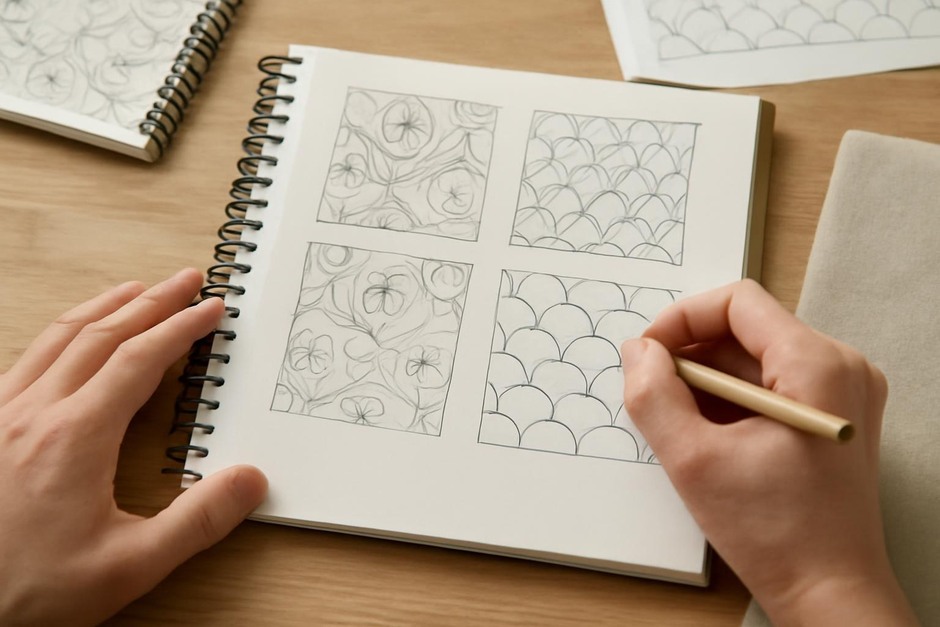
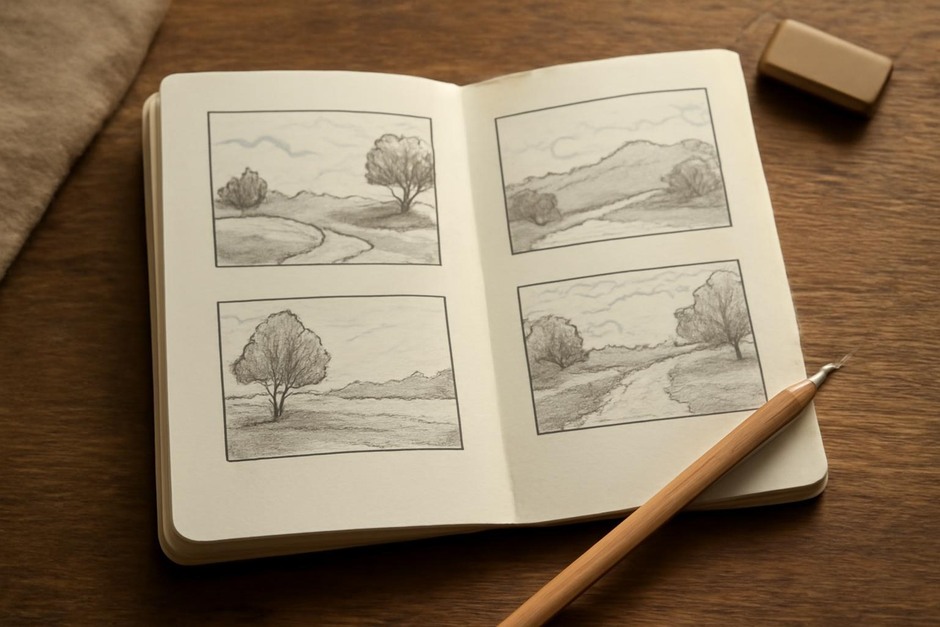
- Thumbnail series – Make at least eight 2 inch by 3 inch thumbnails exploring different focal placements and value patterns.
- Axis and diagonals – Draw the main axes of a scene to locate movement and tension. Try flipping the axis to see alternate dynamics.
- Negative space sketches – Fill the subject with a simple tone and redraw the surrounding negative shapes to test balance.
- Crop studies – Choose a detail and redraw it at tight crop to learn how cropping changes emphasis.
Working checklist
- Start with three quick thumbnails exploring entirely different value structures.
- Pick one thumbnail and make three variations: change the main axis, reverse light and shadow, and alter the scale of the focal element.
- Make a negative space study of the chosen variation.
- Create a tight crop detail at 1:1 scale to study edge relationships.
- Write a one sentence rationale for the chosen composition.
Reflection prompts
- Which thumbnail felt most stable and why?
- How did changing the axis influence implied motion?
- What role did negative space play in directing attention?
Compositional fluency grows from repeated small choices. Using thumbnails and axis studies borrowed from historical methods helps you test many ideas rapidly and reduce wasted work on larger supports. Treat these exercises as cheap experiments: quick, reversible, and illuminating.