Pattern, Repetition, and Rhythm: Techniques from Decorative Traditions
A field guide to pattern making inspired by decorative traditions. Techniques for building repeats, varying scale, and using rhythm in composition.
Why study decorative traditions
Decorative arts refine ways of creating rhythm, scale, and repeated structure. These traditions provide clear rules and variations that can be adapted for painting, textile design, or compositional texture in fine art.
Basic pattern exercises
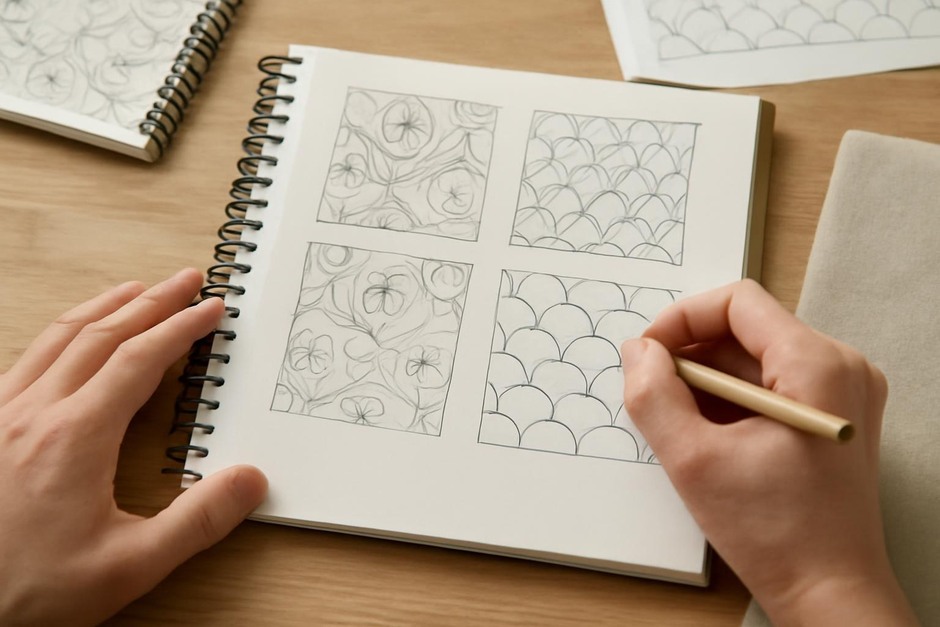
- Single motif repetitions – Design a simple motif and repeat it across a page to study spacing and rhythm.
- Tessellation test – Create a repeated interlocking motif, paying attention to edge continuity.
- Scale variation – Repeat a motif at three scales on one page to test how scale influences rhythm and legibility.
Working checklist
- Draw a motif no larger than a thumbnail.
- Create a grid and repeat the motif across at least three rows.
- Vary spacing in a second repeat to observe the effect on rhythm.
- Make a third repeat using the motif at double scale and note compositional weight shifts.
Compositional uses of repetition
Repetition can unify a composition, lead the eye, or create texture. Historical borders and friezes show how repeat can frame a central image, while textiles demonstrate how rhythm changes with scale and colour alternation.
Reflection prompts
- How did changing spacing alter the perceived speed of the pattern?
- Which scale felt most balanced in relation to an imagined focal point?
- Could one motif be modified to tile more efficiently or to create a different rhythm?
Pattern exercises are low cost and high yield. They train steady hand movement, clarify spacing choices, and reveal how small changes in motif or scale alter overall character. Use these repetitions as warm up practices or as deliberate steps toward integrating rhythm into larger works.